This sophisticated cheese cutting tool is known as a Girolle.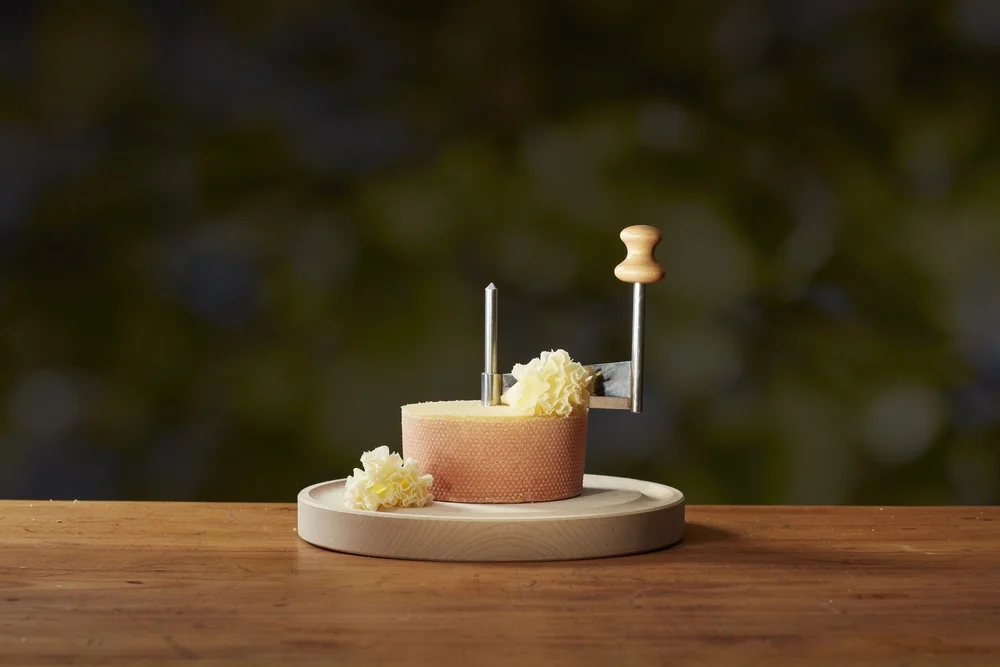
There are many ways to cut and arrange cheese that are pleasing to the eye, but perhaps none are so striking as a perfectly curled cheese rosette. You know it when you see it: a delicate spiral with lacy edges redolent of a flower or seashell. Both flowers and seashells are known to spark joy, but when those eye-pleasing shapes contain a medium of cheese, well that’s just a joy inferno, if you ask me.
If you’ve ever come across such a cheese rosette in the wild, what you’ve likely encountered is Tête de Moine, a Swiss Alpine cheese that shares many important characteristics with several of its Alpine brethren: washed rind, cooked and pressed curd, and raw milk. In the Alpine canon, there’s both Alp Blossom cheese and then there’s a blossom made of Alpine cheese. Both are wondrous to behold, but here we’ll focus on the latter. “It’s a unique shape for food, but also it is something that you can do yourself,” says Amy Thompson, Certified Cheese Professional and USA Ambassador for Tête de Moine AOP.
Amy Thompson, CCP is an ambassador for Tête de Moine AOP.
What enables this fancy formation is a simple yet sophisticated cheese cutting tool known as a Girolle. (An electric version known as a Rosomat is primarily available for restaurants and food service operations.) So, what exactly is a Girolle cheese curler, and perhaps more importantly, do you really need one?
Girolle History
Girolles and a tribute to their founder, Crevoisier. Photo credit Amy Thompson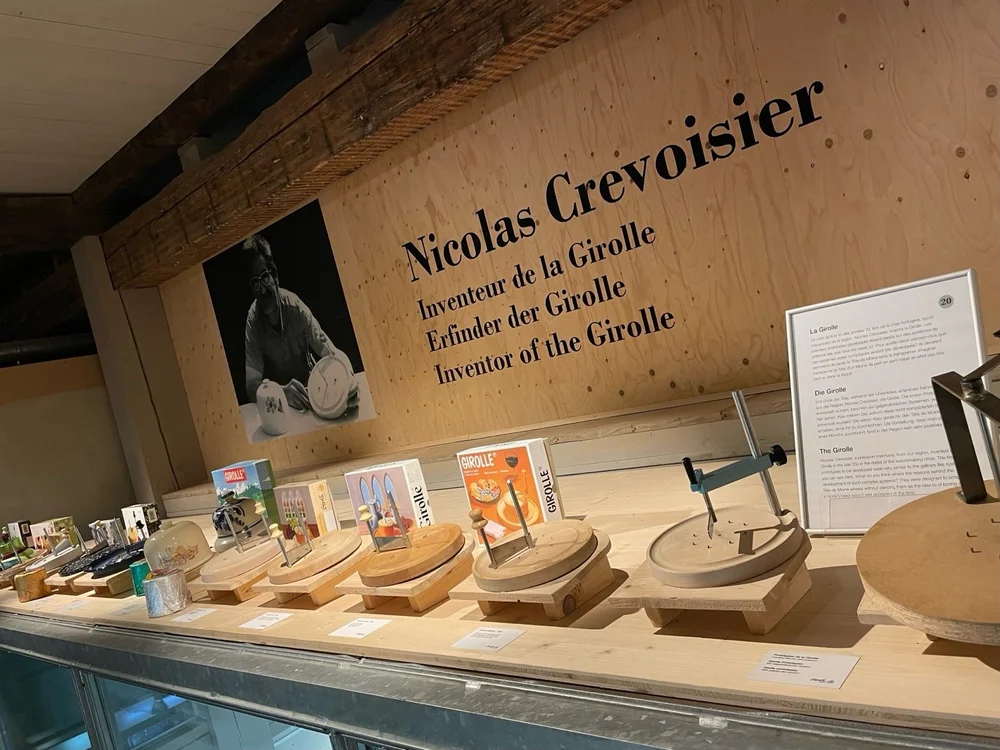
The Girolle was invented in Switzerland in 1982 by local manufacturer Nicolas Crevoisier, who imagined a way to cut Tête de Moine efficiently to make it more approachable for consumers. The move was a savvy one: the eye-catching cheese curls skyrocketed Tête de Moine’s sales in the years that followed.
The look that the Girolle achieves with Tête de Moine is indeed stunning, but its development was also rooted in practicality and history. “The cheese is a small cylinder, which people would typically eat by scraping along the surface with a sharp knife,” explains Thompson. “The exposed top was basically bald, so it looked like a monk’s head,” she says, hence the name “Tête de Moine.” “The scraping of the cheese wasn’t new,” says Thompson. “The Girolle was just a way to make it uniform and make it faster.”
How Does a Girolle Work?
The first Girolle was made in 1982. Photo credit Girolle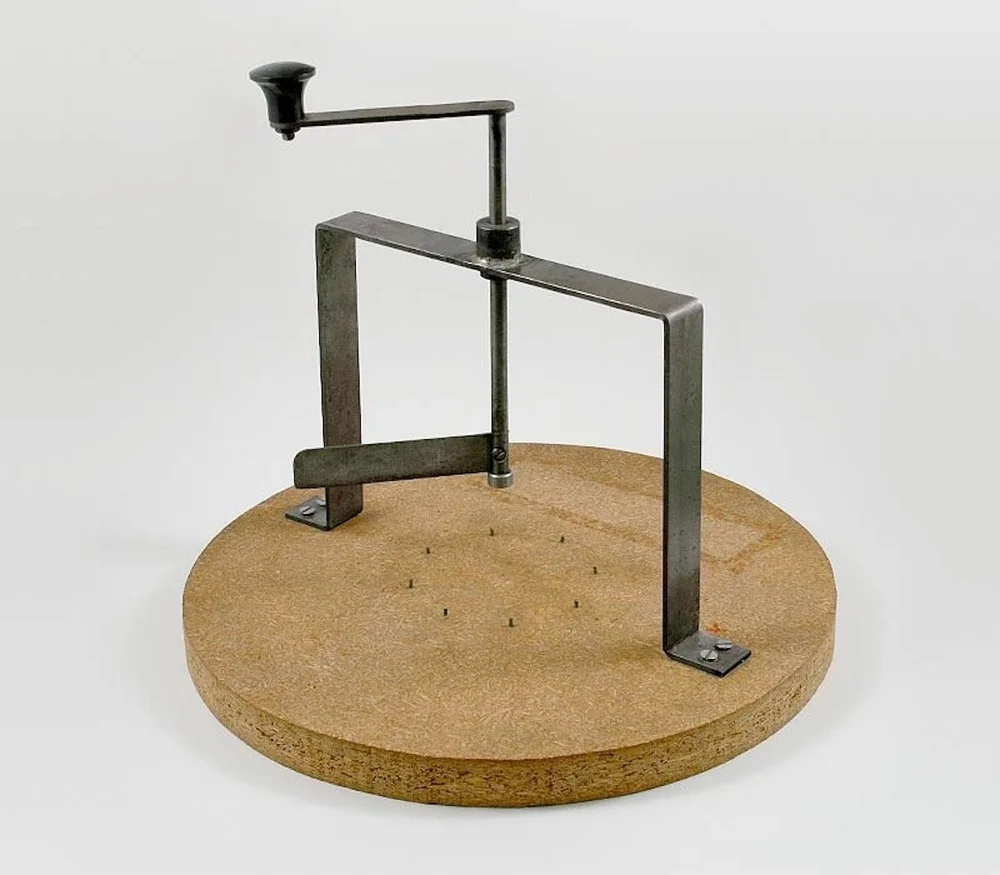
The Girolle consists of a wood base mounted perpendicularly with a metal dowel that anchors a small wheel of cheese, and a scraper edge that lays parallel to the cheese’s surface. A handle attached to the end of the scraper rotates it 360 degrees along the radius of the wheel, taking the thinnest slice with it and curling it in the process. The arc of the Girolle scraper is specific to the radius of Tête de Moine, such that it scrapes the surface of the cheese, but intentionally leaves the rind behind, instead giving a delicate, lacy edge to the cheese.
This transforms not only the appearance of the cheese but also its texture and flavor. “When Tête de Moine is shaved into rosettes or cheese flowers, the aeration definitely gives it a different texture and an enhanced aroma,” says Thompson. “It’s a unique, sense-of-place experience.” The name Girolle comes from the French word for chanterelle mushroom, which the cheese curls resemble.
Can You Curl Other Cheeses with a Girolle?
The Girolle was designed specifically for Tête de Moine cheese. Photo credit Tête de Moine AOP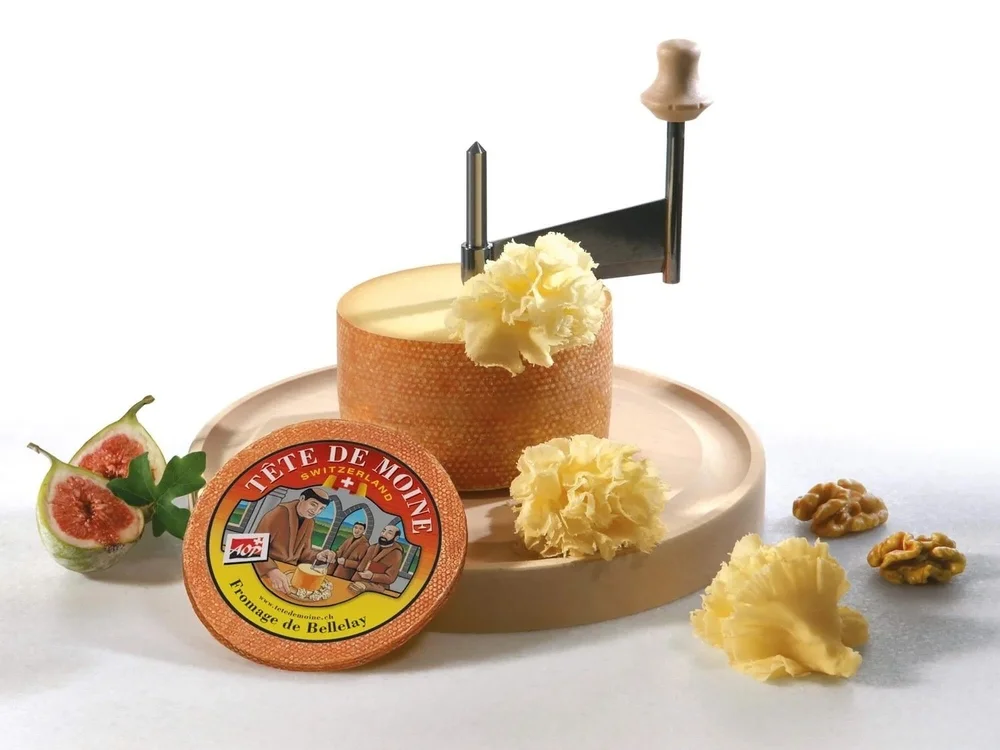
Bear in mind that the Girolle was developed not just for aesthetics, but specifically for Tête de Moine in order to mimic the knife-scraping action that reflected how people were historically eating it. What’s more, particular characteristics of Tête de Moine enable its ability to curl.
“The cheese has a certain elasticity and moisture content,” says Thompson. “It’s the recipe of the cheese that gives it that texture that then makes it able to be made into rosettes.”
Most other Alpine cheeses with a similar nature are too large in diameter to fit on a standard Girolle. Even if such a device existed for Le Gruyère or Appenzeller, it would produce cheese spirals roughly the size of a conch shell. Many other small truckle cheeses are either too soft, which would result in a cheesy paste rather than a clean curl, or too crumbly, resulting in a more rustic outcome than a lacy floret.
That said, several cheese pros have indicated that a few other cheeses can also yield successful results on the Girolle. Small format, sheep’s milk cheeses are the most likely candidates, such as P’tit Basque, Petit Agour, and Tomme Brulée. Semi-young, small format goudas may also produce successful rosettes.
Milwaukee Cheese & Cocktail Bar’s Carnation cocktail features a rosette. Photo credit Hill Valley Dairy
Hill Valley Dairy’s Milwaukee Cheese & Cocktail Bar not only takes the Girolle to Redhead Creamery’s Barbarian, but uses the resulting floret as garnish for an aptly-named Carnation cocktail.
Do You Need a Girolle?
A Girolle has a variety of uses. Photo credit Tête de Moine AOP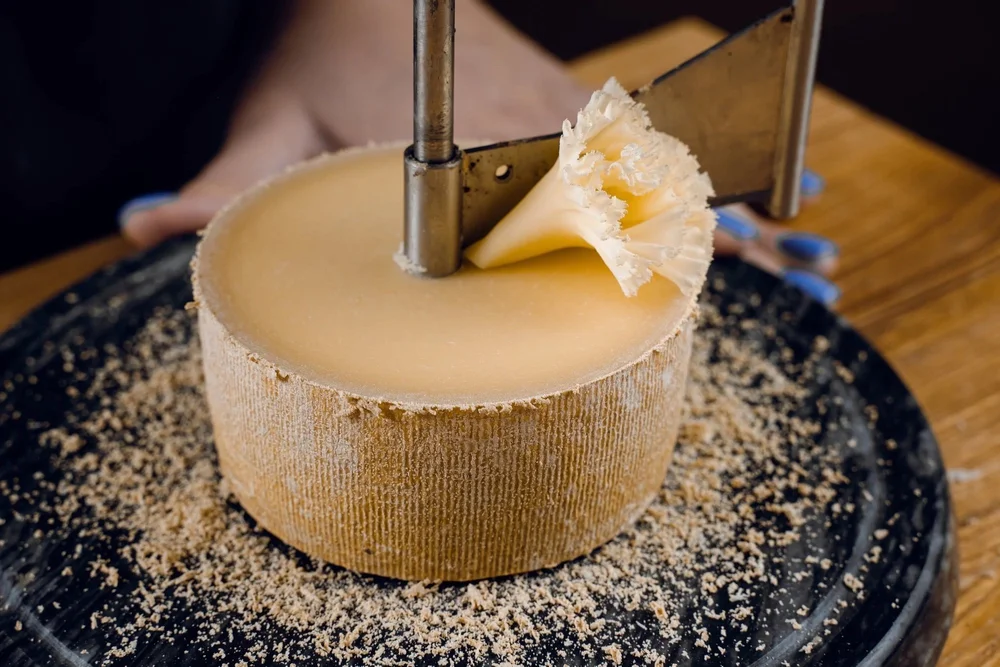
We wish we could tell you that a vegetable peeler would yield the same results as a Girolle, but alas, it does not. “Need” is a provocative word here, but Girolles are pretty accessible, price-wise, with both brand-name Girolles and other cheese curlers retailing for less than $50. Boska sells at least four different models of cheese curlers and claims you can use them for chocolate as well as cheese. It may be a pricey tool among cheese accessories, but it has a variety of uses.
First, a Girolle can be an entertaining lifesaver for unexpected company or if you didn’t remember to temper the cheese ahead of time, as it works best with slightly chilled cheese. “Once Tête de Moine is sliced thin into a rosette, it comes to room temp very quickly,” says Thompson.
If the cocktail garnish above didn’t convince you, consider other entertaining uses for a Girolle, such as making rosettes for salad garnish, composed dishes featuring a single cheese, or simply as a conversation starter. “Anytime you’re having a cheese board, it’s definitely going to be a conversation piece, and it’s fun,” says Thompson. “It’s one thing to pick out a great selection of cheeses, but it’s another thing to get people involved and have them sit around the table and shave some rosettes.”