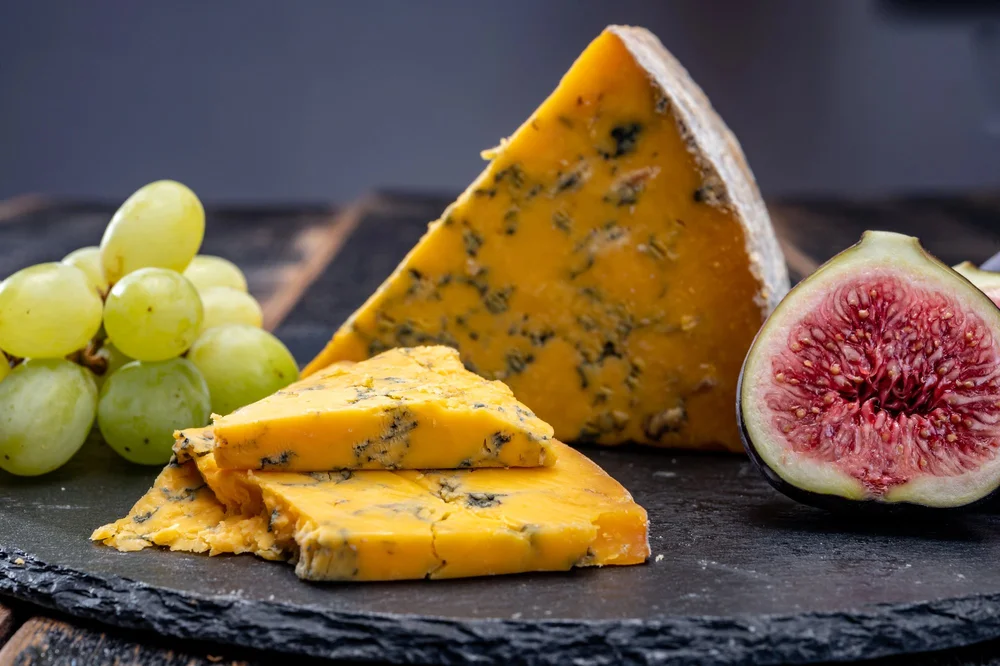
A singular wedge of Shropshire Blue with fruit makes for a cheese plate that’s just as stunning to the palate. Photo credit Depositphotos
“Sometimes the best cheese board is just a big piece of cheese on a board,” wrote Anne-Marie Pietersma in her cheese/rom-com romp I’ll Have What Cheese Having, and I found myself subconsciously declaring, “sing it, sister.” Much as I enthusiastically jumped on the bandwagon of maximalist cheese boards, where every inch of space is accounted for with an array of cheese and accompaniments — a category for which it seems nothing is truly off-limits — I have found myself occasionally longing for simpler times.
On her Substack, Emily in France, Paris-based writer, podcaster, and cheese expert Emily Monaco recently argued that cheese and charcuterie are not always the soulmates we think they are. “But the [French] menu — and above all, the order — also shows you why you’ll never see an American-style charcuterie board in France,” Monaco writes. “In France, charcuterie opens the meal, and cheese closes it.”
Look, I rafted that salami river with the best of them, and I will doubtlessly do it again. High-concept cheese plates are, frankly, fun. But if you’re also feeling like you could sometimes take a break from excessive cheese-scaping, here is your permission to do so. Several cheese pros chimed in on the benefits of — and strategies for — a simpler cheese plate.
Let the Cheese Be the Star
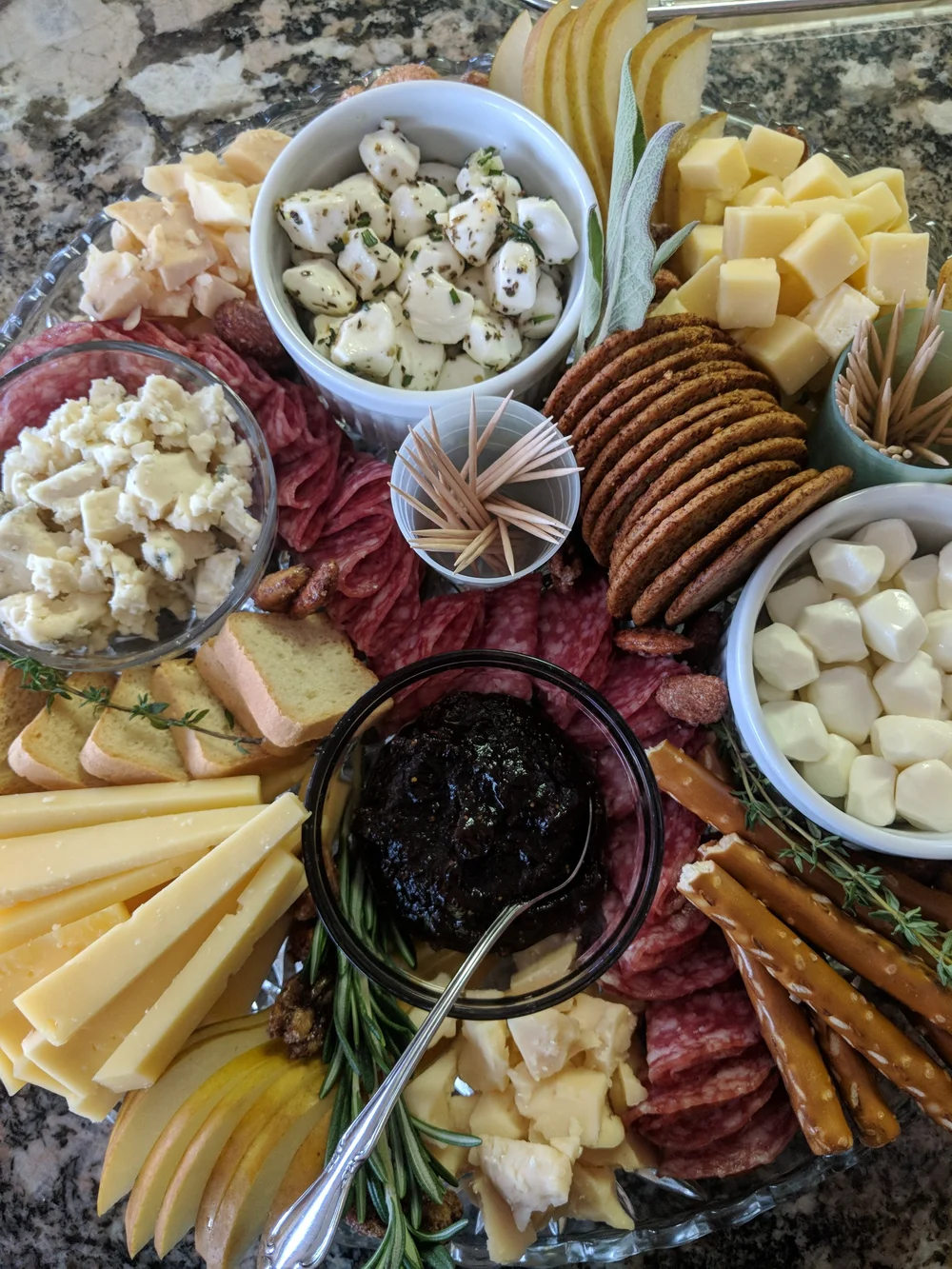
Where does one even begin? Photo credit Pamela Vachon
First and foremost, let us begin by not forgetting that the real star of a cheese board should be the cheese, not the design. “American-style cheese boards are definitely beautiful, but in my humble opinion, all those added accoutrements can be distracting,” says Monaco. “In France, the cheese board is all about the cheese.” Whether French, American, or otherwise, a perfectly ripe, complex cheese rarely needs excessive accompaniments to shine.
If your aim is French minimalism, Monaco offers this advice: “I’d counsel that less is more, and thoughtful pairings are more exciting than maximalism for the sake of maximalism,” she says. “I might include, for example, a sheep’s milk tomme with some cherry jam or membrillo, or a small jar of honey to go with some salty Roquefort.”
Emily Monaco. Photo credit Charlotte Bailey

Even cheese personalities who are well known for their sense of style occasionally worship a simplified, single-cheese plate.
“I love extravagant boards, but there’s something special about putting all the focus on one cheese,” says Erika Kubick, author of Cheese Sex Death: A Bible for the Cheese Obsessed. “It gives the cheese the spotlight and it starts a conversation about where it’s from, and how it tastes different from person to person.” Kubick’s popular Substack and Instagram accounts have featured single cheese heroes such as Robiola, Pantaleo, and Valençay with minimal, strategic accompaniments.
Make the Cheese Accessible
Emilia D’Albero

The best extravagant cheese boards often include pre-cut and geometrically arranged cheeses that make them easy to grab — which is especially important within that more-is-more, maximalist aesthetic. You’ll occasionally find some small-format soft cheeses, however, and even some large-format hunks left whole on such a board. In those cases, “piling extras into every naked gap doesn’t only make it hard to focus on the real stars,” says Monaco, “it makes it unwieldy.”
If there’s no graceful way to take a bit of cheese without creating an earthquake for the other components on the board, that starts to feel more like hostility toward your guests, not hospitality. “It shouldn’t feel daunting to have a snack,” concurs Emilia D’Albero, award-winning cheesemonger and educator. “It all comes down to accessibility — you don’t want to overwhelm your guests, you want them to feel at ease and make it easy for them to grab what they want from the board.”
Whether you’re serving camembert or Comté, you can also save yourself some hosting effort by leaving them whole, so long as you leave a wide enough berth to allow slithering room for soft cheeses, and make slicing from firmer cheeses a realistic possibility.
Preserve the Aesthetics
A modern minimalist cheese plate featuring Blakesville Creamery Linedeline that’s no less stunning. Photo credit Evan Dannells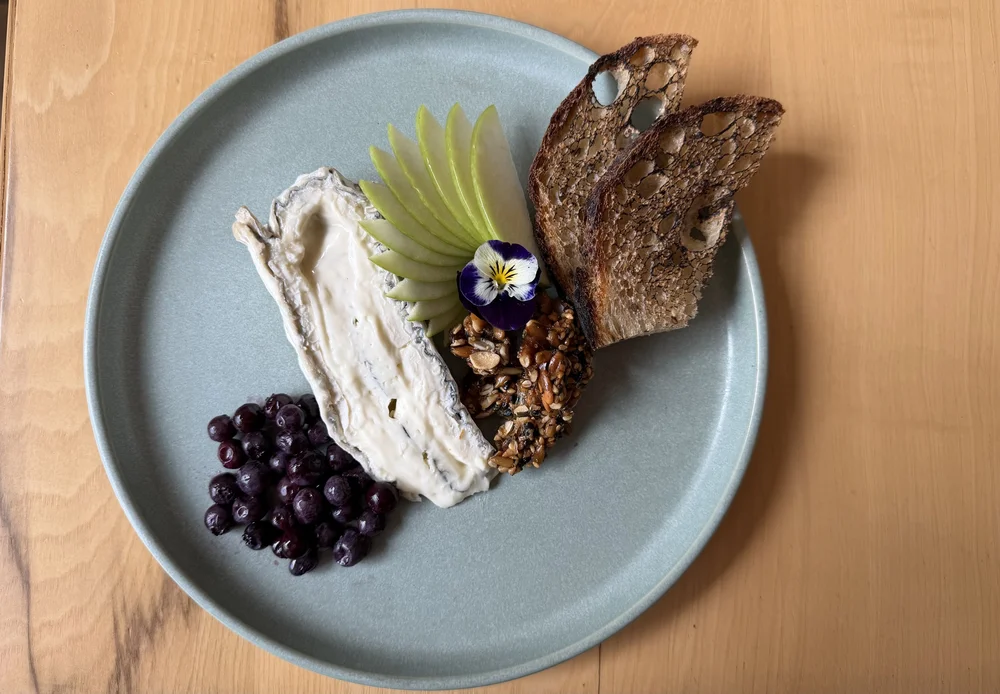
My first experience with a grazing table — the ultimate expression of maximalist cheese plating — taught me the “camera eats first” principle while traveling with a group of both food journalists and influencers. (Reader: the admonishment at my enthusiasm for simply grazing before picture time was not gentle.) Though I was but a burgeoning food writer then, the point was rightfully taken. Whether you find this camera moment annoying or not, the maximalist cheese plate/grazing table aesthetic is tarnished, not enhanced, by the act of consumption: the ultimate catch-22 of all beautifully arranged food.
Even while frequently presenting a high-concept cheese plate — whether horoscope-inspired, built around spirit pairings, or merely “cleaning out the fridge and pantry” — the aesthetic only holds before anyone has touched it. The cheese plate goes from perfectly Instagrammable to not at all in a single bite. If you’re late to the party, you’re late to the photo op.
With a large-format whole cheese, the look holds up even while the cheese is consumed, allowing more people to be dazzled by it over the course of an event. “You also get the drama of one big piece of cheese,” says Kubick, “waning like a full moon throughout the duration of the gathering.”